The Who Wont Get Fooled Again Song Length
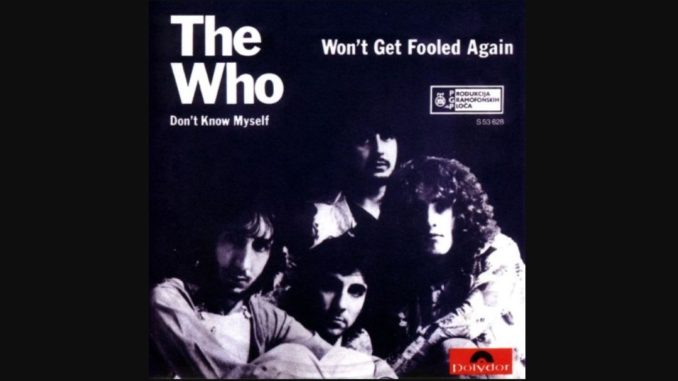
Won't Go Fooled Once more is one of the biggest archetype rock anthems of all time. Written by Pete Townshend and released by The Who as a single in June 1971, reaching the UK height ten. It was the last track on the incredible Who's Next album, released August 1971.
The runway was originally conceived for an entirely different project. Following the success of Tommy, the band'due south 1969 double concept anthology that sent The Who into rock'due south elite partitioning, Townshend started piece of work on a new conceptual project chosen Lifehouse.
The story was an intriguing one, if a bit abstruse. It was designed to prove how spiritual enlightenment could be obtained via a combination of band and audience. The concept was imagined as a multi-media exercise, involving a movie and theatrical alive performances in add-on to the music. Fifty-fifty the music was to be adult in a new way: through interaction with a live audience. The trouble was that nobody but Townshend fully understood what it was all most thematically, what it would entail, or how the execution actually work work.
Lifehouse is set in the near future in a guild in which music is banned and about of the population live indoors in government-controlled experience suits connected through a grid. A rebel, Bobby, broadcasts rock music into the suits, assuasive people to remove them and become more enlightened.
Interestingly, the story describes technology that would be developed years subsequently. For case, the grid resembles the net, and people'due south experiences inside the experience suits basically describe a grade of virtual reality.
Bobby finds that at that place is a universal chord that is so pure that it has the power to restore harmony and enlighten anyone who hears it. Won't Get Fooled Again was written for the stop of the opera, when the people are free and looking to overthrow the leadership. Bobby is killed and the universal chord is finally sounded. The main characters disappear, leaving behind the government and army to take at each other.
Nosotros'll be fighting in the streets
With our children at our feet
And the morals that they worship will exist gone
And the men who spurred united states on
Sit in judgment of all wrong
They make up one's mind and the shotgun sings the songI'll tip my hat to the new constitution
Take a bow for the new revolution
Smile and grin at the alter all around
Pick upwards my guitar and play
Just similar yesterday
Then I'll go on my knees and pray
We don't get fooled again
Townshend realised that the newly emerging synthesizers would let him to communicate the ideas he had to a mass audition. He had met the BBC Radiophonic Workshop which gave him ideas for capturing human personality within music. Townshend interviewed several people with general practitioner-style questions, and captured their heartbeat, brainwaves and astrological charts, converting the effect into a series of sound pulses.
For the demo of Won't Go Fooled Again, he linked a Lowrey organ into an EMS VCS 3 filter that played back the pulse-coded modulations from his experiments. He subsequently upgraded to an ARP 2500. The synthesizer did not play whatsoever sounds directly equally it was monophonic; instead it modified the block chords on the organ as an input signal.
These type of arpeggiated synthesizer sounds would be used on ii songs on the anthology: opener Baba O'Riley and closer Won't Get Fooled Again, bookending the album with songs featuring this audio – and quite prominently at that. The nerve of in particular opening the album with a huge, extended synthesizer intro, was a ballsy move. It was besides very unique – non just the sonic quality of the audio itself, but the percussive rhythms that the patterns infused into their songs.
It almost certainly was the starting time time a major rock ring had used a synthesizer like this. Others may accept wanted to or would have leapt at the gamble, but the instrument was but uncommon earlier Townshend got his hands on one. Besides, very few knew how to work them and they were actually hard to program. Townshend spent endless weeks holed up in the studio getting to the bottom of this instrument and the new opportunity information technology offered, putting in time, effort, and pure stamina that others only may not have had.
The demo, recorded at a slower tempo than the version by the Who, was completed by Townshend overdubbing drums, bass, electric guitar, vocals and handclaps. In the Classic Albums documentary for the Who'southward Next album, Townshend said: "When I did this audio for Won't Get Fooled Again I didn't accept the full equipment. It arrived during the making of the demos. By the time I had finished the demos I knew how to work it, but what I did have was a much simpler organ synthesizer. I took the output of the organ and put it through a filter, which is what they call 'sample and concur' – y'all get these random voltages coming out. I suppose I was just sitting there and playing it for 60 minutes after hr, getting into it. The chords I used were very simple – virtually kind of naïvely unproblematic, but then once again, the cease upshot is extraordinarily harmonically complex."
What many assume to be a loop, is actually a alive performance with many subtle variations, making a loop incommunicable.
Townshend'due south demo of the song contains a much more straightforward drum and bass pattern than the ones Keith Moon and John Entwistle would add to the vocal. "When I start started playing the drums I tried to emulate Keith, but in the end I idea, f*ck it. I don't really want to play like that." He knew that the songs would still become the inevitable and inimitable stamp by the other ring members, making information technology into a vocal by The Who rather than Pete Townshend solo.
At a point well into the song, there is an organ solo with the aforementioned arpeggiated rhythm. "That part is something I couldn't have written on paper," said Townshend. "What's interesting at that place is what happens to the organ. The part has been playing in the background all forth, when it of a sudden becomes a solo. The part is me playing, and it turns into something beautiful and spontaneous. Something very disciplined. I'yard just following it – I did non write it, I follow the music."
That solo spot became a pivotal point in the alive shows as well, with incredible laser effects casting a spectacular display over the stage, Roger Daltrey's shadow reappearing in the middle, backed by Keith Moon'due south incredible percussive work, before the band explode back into it – with THAT scream.
Roger Daltrey's scream towards the end of the solo, right before the "come across the new boss, same as the old boss" department, is simply incredible. Information technology is largely considered one of the best recorded screams on any rock song. According to fable, it was such a convincing wail the rest of the band, who were lunching nearby, thought Daltrey was having a ball with the engineer. Who biographer Dave Marsh described it as "the greatest scream of a career filled with screams".
The lyrics of Won't Be Fooled Again has as interesting a backstory as the music. To fully sympathise everything that went into the vocal, we need to look at the commune on Eel Pie Isle, right near a place on the River Themes in Richmond, London, where Pete Townshend lived at the time. There was an active commune on the isle at the time, situated in what used to be a hotel. "In that location was similar a love affair going on between me an them," Townshend said. "They dug me because I was like a figurehead in a grouping, and I dug them because I could see what was going on over in that location. At one indicate in that location was an amazing scene where the commune was really working, only then the acid started flowing and I got on the finish of some psychotic conversations."
In the documentary The History of The Who, Townshend offered more than detail on what happened: "When I wrote Won't Get Fooled Again I was a immature man with a family unit. I take a option virtually what I can and cannot do, and what I can and cannot call up. The sensibility of the twenty-four hour period was that the artist – the stone musician – was the holding of the people. It was the musician who should be liberated. This was exacerbated a bit by the fact that I lived right near a place on the River Themes called Eel Pie Island, which had been taken over by a bunch of hippies and Grateful Dead fans, and the Pig Pen… all that agglomeration came i day and distributed heroin and LSD. They used to come and knock at the door and say, "requite u.s.a. nutrient"! I'd say okay, and I'll give 'em some food. The side by side day they were back, and said "give us more food"! I said okay again, and of course the next they were back yet once again proverb "give us more food!" I finally said, "we've run out of food." They went, what? I repeated "we've run out of nutrient." They could not cover this. "Simply… nosotros want more food!" Later they would come by and say "give us a machine – we want to liberate your car!" I told a story about them to a friend once, and my married woman got so angry crusade I'd never told her about information technology. She hates it when she hears things second hand, and this ane was about one of these guys knocking at the door saying "we've come to liberate your baby!" I mean… Jesus F*cking Christ. They were wackos. And that was the climate in which I wrote Won't Get Fooled Again. It caused quite a lot of difficulty for me, but I had to call back nigh it and I had to stand past information technology."
The Woodstock festival was besides an influence on this song. Nearly songs inspired past Woodstock follow the peace and love narrative, just Townshend had a very different take.
The Who played on twenty-four hour period two, going on at the ludicrous hour of five in the morning. During their set up, the activist Abbie Hoffman came on phase unannounced and commandeered the microphone. Accounts differ on whether Townshend belted him with his guitar, merely he certainly did not want to provide a platform for any cause. "I wrote Won't Get Fooled Again as a reaction to all that," he explained to Creem in 1982. "Every bit in, 'Exit me out of it; I don't think y'all would be any amend than the other lot!'"
The song has been taken as a phone call to arms for a number of causes over the years, which is the exact contrary of what its writer had in mind. In The History of The Who documentary, Townshend said, "Strangely enough, it'southward the kind of song which is adopted for many causes, yous know. We have to keep reminding people that this is well-nigh our right to stand away from causes. You lot know, nosotros choose not to be fooled past your rhetoric, by your politicisation, past your spin. We think for ourselves, and we likewise have the right to opt out. I think what I felt at the time was that I if I had been confronted with people coming to say 'nosotros want the money back,' I would just say that you can't take it and I'g available for hire. If you don't desire to rent me, don't hire me. Yous can't liberate me – I'one thousand not your property."
The change, it had to come
We knew it all along
Nosotros were liberated from the fold, that'south all
And the earth looks just the aforementioned
And history ain't changed
Cause the banners, they are flown in the next war
Townshend described the song as one "that screams disobedience at those who feel any cause is better than no cause." He later said that the song was non strictly anti-revolution despite the lyric "We'll be fighting in the streets", simply stressed that revolution could be unpredictable, adding, "Don't expect to meet what you look to see. Expect nix and you might gain everything."
Bassist John Entwistle later said that the song showed Townshend "proverb things that really mattered to him, and saying them for the first time."
One of the pivotal lyrics to ever come from a The Who song are found at the end of this song.
Meet the new boss
Same as the onetime boss
The song has often been taken up in an anthemic sense, but these words more than than any other should make information technology clear that it'due south actually a cautionary piece. Townshend said: "Won't Become Fooled Again was not a defined statement. It was a plea! Information technology was a plea, because you lot know – in the Lifehouse story, it said; please don't experience considering you lot've come up to the concert, to this place, that you've got an reply. Please don't make me on the phase the new dominate. Considering I'm just the same as the guy who was up here before. You're in accuse."
In looking closer at the Lifehouse story and Won't Get Fooled Again, you realise that it is not describing utopia. Information technology is much closer to dystopia. The current world order does not work and people are paying the price for it. The rock opera depicts leadership as a dangerous idea, which may be some of the reason why it was then hard to pull off. Information technology put forth the idea that deportment take consequences. The order of the day back then was that actions and revolutions were supposed to have glorious results – not consequences. Was the world prepare for such a message back and then? It may take been more convenient to lump it in with the political protestation songs of the era. Some no doubt idea that'due south what the vocal was about in any case.
Most of the songs that brand up the Lifehouse stone opera reflects a striving to try and make more of ourselves – to get more conscious, more aware, more than complete equally man beings. Won't Go Fooled Again stands out on its ain because information technology carries a stiff message of encouraging self-empowerment and thinking for yourself. Merely, as office of Lifehouse, it was function of an fifty-fifty bigger message.
The Who's first attempt to tape the vocal was at the Record Plant on West 44 Street, New York City, on xvi March 1971. Manager Kit Lambert had recommended the studio to the grouping, which led to his producer credit, though the de facto piece of work was done by Felix Pappalardi from the band Mountain. This have featured Pappalardi'south bandmate, Leslie Westward, on lead guitar.
Lambert proved to exist unable to mix the track, and a fresh attempt at recording was made at the kickoff of April at Mick Jagger's business firm, Stargroves, using the Rolling Stones Mobile Studio. Glyn Johns was invited to help with production, and he decided to re-use the synthesized organ rail from Townshend'southward original demo, every bit the re-recording of the part in New York was felt to be junior to the original.
Keith Moon had to carefully synchronise his pulsate playing with the synthesizer, while Townshend and Entwistle played electrical guitar and bass. Townshend played a 1959 Gretsch 6120 Chet Atkins hollow body guitar fed through an Edwards book pedal to a Fender Bandmaster amp, all of which he had been given by Joe Walsh while in New York. This combination became his main electric guitar recording setup for subsequent albums.
The Stargroves recording of the vocal was intended equally a demo recording, but the end result sounded so skillful that they decided to utilise it as the terminal take. Some overdubs, including an acoustic guitar function played by Townshend, were recorded at Olympic Studios at the terminate of April. The rails was mixed at Isle Studios by Johns on 28 May.
During this process, Lifehouse every bit a project was abandoned. Yous could say it complanate under its own weight, with Townshend never fully beingness able to explain the full concept or get others to share his own enthusiasm for the project. He did not have the forcefulness to conduct all the ideas through on his own. Producer Glyn Johns felt that most of the songs they had been working on, including Won't Go Fooled Once more, were then good that it did not matter. The all-time of them could simply exist released as a single album of standalone songs. This became Who's Adjacent.
Without the concept of Lifehouse to provide an overarching context, the songs now had to stand on their own legs, providing their own inner meaning. Won't Be Fooled Again was meant to provide a climax in the Lifehouse story, but the vocal would is then powerful in whatever instance that it ends upwardly providing a similar climax to the Who's Adjacent album.
Roger Daltrey felt that having gone through the initial phases of the Lifehouse project had been very beneficial to the album they ended upwards with. "If nosotros hadn't been given the hazard to at least be working for this kind of ethereal project of Pete'due south – it was going to be a concept, a pic and this and that – we would have just gone into the studio with demos and recorded it the way all our other albums were recorded. Whereas, this album is a real organic Who album, and information technology's got much more than of what The Who really were about. It has much more of our stage presence, because we knew the songs so well."
This is a very practiced point, and every musician delivered brilliantly. A lot of the songs had been explored in rehearsal a alive to an extent that they normally didn't for new fabric. Whether you focus on the vocals, guitar, bass, or drums, the parts are incredibly well developed. They managed to display the usual levels of virtuosity while fitting it in naturally within the song. Nothing sounds overwrought – information technology just sounds amazing.
The album version runs 8:30. The single was shortened to 3:35 then radio stations would play it. The ring was not happy that the song had to exist edited, and Daltrey has expressed item unhappiness most it. He recalled toUncut mag, "I hated it when they chopped information technology down. I used to say 'F*ck it, put it out every bit eight minutes', only there'd always be some excuse about non fitting it on or some technical thing at the pressing constitute. After that we started to lose involvement in singles considering they'd cut them to bits. We thought, 'What's the point? Our music's evolved past the three-infinitesimal barrier and if they tin't adjust that we're just gonna have to live on albums.'"
The single was released on 25 June 1971, replacing Behind Blue Eyes which the group felt didn't fit The Who'south established musical style. It was released in July in the Us. The single reached #ix in the UK charts and #15 in the Usa. Initial publicity material showed an abandoned cover of Who's Next featuring Moon dressed in drag and brandishing a whip.
RELATED ARTICLE: The story of the «Who's Next» album comprehend
The total-length version of the song appeared as the endmost track of Who's Next, released 14 (US)/27 (UK) August. Information technology fabricated information technology to #iv on the U.s. Billboard charts, going all the way to #i in the Great britain – the only Who album to exercise and then. Won't Get Fooled Over again drew strong praise from critics, who were impressed that a synthesizer had managed to be integrated so successfully inside a stone song.
The song would immediately get a mainstay in The Who'southward live shows, having been function of every Who concert since its release – unremarkably as the set closer and sometimes extended slightly to permit Townshend to smash his guitar or Moon to kicking over his drumkit. The group would perform it live over the synthesizer part beingness played on a backing tape, which required Moon to wear headphones to hear a click track, assuasive him to play in sync.
It was the last track Moon played live in front of a paying audience on 21 October 1976, and the last vocal he e'er played with the Who at Shepperton Studios on 25 May 1978, which was captured on the documentary film The Kids Are Alright.
Several alive and culling versions of the song have been released on CD or DVD. In 2003, a palatial version of Who'due south Next was reissued to include the Record Found recording of the track from March 1971. Information technology also included the earliest known live version from the Young Vic on 26 April 1971.
In its May 26, 2006 issue, the conservativeNational Review magazine published a listing of "The l greatest conservative rock songs." Won't Get Fooled Again was ranked song number i. Pete Townsend responded on his web log as follows: "It is not precisely a song that decries revolution – it suggests that nosotros will indeed fight in the streets – but that revolution, similar all activeness can take results we cannot predict. Don't await to see what yous expect to see. Expect null and you might proceeds everything." Townsend so goes on to explain that the vocal was simply "Meant to let politicians and revolutionaries alike know that what lay in the centre of my life was non for sale, and could not be co-opted into any obvious crusade."
Roger Daltrey has in later years admitted that the frequent airing of the song may accept pushed it over the border for him. "That'due south the simply song I'k bloody bored shitless with," he toldRolling Rock in 2018. Interestingly, that has non prevented Daltrey from well-nigh e'er including the song in his solo concerts – as Entwistle and Townshend always did.
For ameliorate or worse, this is the song many will associate The Who with. My Generation was a solid anthem for the 1960s, but they managed to redefine themselves and found Won't Get Fooled Over again as their new anthem for the 1970s onward – and information technology continues to exist timeless.
Source: https://norselandsrock.com/wont-get-fooled-again-the-who/
0 Response to "The Who Wont Get Fooled Again Song Length"
Postar um comentário